

The following is from a letter written by Will Grummett in 1923 and published in the Toronto Globe and Mail newspaper:
During the Great War, I served with the Imperial Army in Mesopotamia, and toward the close of that campaign, during the latter part of 1918 I was sent up into Persia to aid in the rescue of that part of the Armenian people who had taken refuge at Lake Urmia, in Northern Persia. We were told we had 80,000 Armenians to bring down into Mesopotamia where they could be cared for by the British Forces. From records I kept of the refugees passing through my hands I believe 57000 refugees reached the concentration camp at Baqubah. The rest presumably perished on the way. The total distance traveled was 500 miles. The death rate per day was very heavy on the 60 miles of route over which I had charge.
W.J. Grummett, Toronto Globe and Mail, April 30, 1923.
On his return to Mesopotamia from India, Will Grummett went to Khanaqin to undertake work, “in connection with refugees.”(Regimental Diary of the 2nd Battalion Norfolk Regiment, Sept. 1918) Those refugees were both Armenian and Assyrian people who had fled the Lake Urmia area in Persia (Iran) for safety in hastily constructed British camps around Hamadan in southern Persia.

Following the Russian revolution and the departure of the Russians from the war, Russia’s former Armenian and Assyrian allies were left to fend for themselves against the Turks. They held on for some time, but lacking numbers and supply they, eventually, retreated. Unlike a military retreat, however, this exodus included the soldiers and their displaced families. They retreated to Hamadan covering 250 miles in difficult country. Once at Hamadan, however, the British Army decided that they could be better cared for closer to British controlled rail lines in Mesopotamia.
It would be untrue to characterize this effort to aid the Armenian and Assyrian refugees as entirely motivated by humanitarian concerns. In his book, The Baqubah Refugee Camp, Brigadier General H. H. Austin, British commander of the camp, stated,
“Having regard to the great difficulties that were already being experienced in maintaining the British forces in Persia, spread out to the Caspian, it is obvious that the advent of tens of thousands of destitute men, women and children at Hamadan seriously aggravated the problem of maintenance along the Persian lines of communication.” (Austin, 1920)
General Austin goes on to point out that the British wasted little time in recruiting the “more robust men” (his term) from those seeking refuge at Hamadan, to an “irregular force for fighting in Persia” and the others, including one would suppose, less able men, “should be utilized as Labour Battalions to improve existing road communications on the Persian plateau.”(Austin, 1920) I doubt there was a choice for these men and teen-aged boys, to serve or not, and they were simply assigned to one of the groups and separated from their families. (Ishaya, 2004) Men who were unfit for the Irregular or Labour battalions, women and children, had to get themselves to the new camp at Baqubah. Between September and November of 1918, between 50000 and 60000 refugees took to the road once again.
Will’s job was to protect the refugees as they passed along the caravan route between Hamadan and Khanaqin. He doesn’t provide details in his letter to the Globe and Mail, except that British units, probably platoons had charge of 60 mile stretches of the road. Beyond their usual kit it is not clear what resources Will was given to aid the sick and desperately hungry. Food was scarce. The entire region was suffering through famine and had been for more than a year. The rival armies, first the Turks and the Russians, then the British had commandeered much of the available food. I doubt Will had much to give except the protection his men could provide.
It is not a certainty, but one would hope that the refugees were given rations, water and basic necessities as they left the temporary British camps. What is clear is that the refugees must have been in a weakened and very compromised state, having only recently survived the trip from Urmia. I doubt they were ready to move on but they had no real choice, so they set off on another 250 mile trek, this time through the passes of the Zagros Mountains, the Jebel Hamrin foothills and the arid plains of eastern Mesopotamia bound for the promised safety of the camp at Baqubah. They did so on foot, donkey, horseback, mule and camel. Will’s pictures below document the exodus and the various methods of travel.


Just as their transport was whatever they had or could get, so to where their shelters. In the photograph below Will documented a temporary resting camp along the road to Baqubah.

First hand accounts of the exodus from Lake Urmia to Baqubah are difficult to come by. Fortunately one has been provided through thes kind permission of Mr. Gary Daniels. His Grandmother, Sophia Daniels, then a 16 year old girl recounted the journey as an elderly lady in her late 70s or early 80s.
Sophia’s account – The following is part of a transcription from a recording by Sophia Daniels recounting her journey from Urmia to Hamadan and then to the Baquba refugee camp. It was about a 25-day march to Hamadan beginning on or about July 31, 1918.
British plane landed, uh, by city of Urmia, well we were amazed! What was..we never saw airplane before. When we that people were describing,..we went to pick something. It was Summertime and while we were coming there was mount, Assyrians from mountains, and they keep on saying “Para la sheetala, para la sheetala”, uh, you know, “The flyer is, the flyer is came, the one flyer is came, you know. Now we don’t even know what they taking about it. So we came close to city and we saw some, uh, Assyrians from our home town, Iranian, and not from mountains. And we asked them, I said “Those people from mountains been saying “para la sheetala” what they talking about?”. That something, that, uh, like bird flies. Something was flying. “The flyer is here!. The flyer is here!”. And I don’t know what they, what they mean. And we asked them, I said “That’s what this mountaineers were telling, telling us. What is that? What they mean?”. “Oh!”, they said uh, “British sent a plane and a few people in it to tell us that they’re not able to come to us, but we should go to them.”Again we have to walk. So anyway, uh, then we went to the city and, uh, So, everybody was there around that plane. They were describing, uh, “It has wings”, they said. “It’s..they’re this long, it’s just like a bird!”. Well, we want to see it for ourself. We’re running and we went there and all around that plane, then they stayed for a awhile. They took off. They went back. And then we got ready and we had to walk again. I don’t know how long it took us til we met with British.
We didn’t have no food, nothing. For four days I didn’t have anything to eat. Uh, when I haven’t eat, eaten for four days then we found that, uh, place that we, there was, uh, …you
have to go I don’t know how many steps to get to water. It was like a spring. We went down and I drank so much water. I said “I don’t want water anymore. I won’t drink anymore. I won’t get thirsty”. But I walk away from it, I was thirsty again. We don’t dare to go back again because we’re running away. We’re fleeing away. So anyway, we had water there. It was hot, yes. And we were..but nights were cool. And, uh, I still have the scars. We camped somewhere in, in, around, around the mountains. This way there were so many mountains. And then there was young lady with me, I lost my mother. I don’t where. And then they were hungry and this woman, she had a fire and we, we went to get warmed up there little bit. She said “If you take care of this, you make this bread for me, I’ll give you some”. So what, gladly I did. And she had some fire there and something like, uh, tin on it, so we fixed that bread and we cooked it and she gave us one piece. Not one bread like American bread, just a flat piece. So we ate that and then, I was so close that fire I was just taking those stones. I..in the morning and I woke up, I don’t know how many stones were in my skin, small stones from the, around the fire, you know. So anyway, they were burned and I didn’t even wake up, I was so tired. For long time I could see the scars, but they’re gone now. So anyway, uh, then nothing to eat. I don’t wanted food. I want water. There was no water. You could see the, all the bodies that they were dead. Our people. They were dying from hunger, from…
We came someplace to cross the river, and this side is town, and on the mountains they’re ready to fire on us, and this is the river. And the town is like this, you know, same. We passed the town and then we know they’re gonna…they’re firing. The bullets, they’re just coming. You know, not one bullet touch me. I been in firing five times. Then there were a lot of bombs. I, I can’t explain, this is miracle. God was so good to me. It went down. It didn’t explode. Uh, so much dirt thrown air. We just run away.
So anyway, there was young man. I said “Please kill us. So they won’t, ..you know”. He said “You know what? Get hold of my horse’s tail. We gonna cross. We’ll cross the, cross the, the river”. So we got across. He said “Aren’t you glad I didn’t kill you”?”. So what? We went little way, they fire again. Just keep on going like that til we come to, uh, English, where was it? In Hamadan. We walked towards, uh, Bagdad. In Mesopotamia they used to call it, but we’re still in Iran. We walking, we came to this city of Hamadan. I don’t know how long it took us. When we came there one Iranian man, with a few people with him, was sitting there on the road. He had big piles of bread like this, anybody was passing by he was giving them some bread. Wasn’t that nice of him? That Iranian man gave us piece of bread.
So, uh, I lost my mother. Uh, til, til, ya, til we got to Hamadan. So there is, uh, one lady. She felt so sorry. I was with one woman, she had a son I think he was eight years old. We had the same name. We’re walking, we came to the gate to walk in the city, she standing there. When she see us, she cried. She said “Come on. I’ll take you to my house”. We don’t know where to go, what to do. She took us to her house to get us bath and everything. She combed my hair, took everything, everything was in my hair, you know. So anyway, she said “You know what?” in the morning she said “I’m going to take you someplace. Hokus, Hokus effendi”. He was, he’s Armenian. He’s very rich man. And he is with British, he’s working with them. So she took us in the morning there and they had big place in the country. And then this, uh, road that you walk in their farm that, both sides are roses. Just beautiful, vineyards and everything. And is wife was standing on balcony. When she saw us, she was so happy, she came down. She said “Thank you” to her husband. Her husband wasn’t there. He was in office. But she took us to her husband’s office. He said “Take them to my house”. And she was thanking him a lot, her husband “Thank you for saving them for me”. She liked me so much, ha. So, she had one son, two daughters. This Effendi and his wife. So we stayed with them and then at the evening he closed the office, he came home. And then dinner was ready. He had servants and everything, cook. Uh, table is set, dinner is ready by the water, water pool, you know. And he want us to eat with them. So we sat at the table. They start, they start eating, I run away. I left the table. I start crying. And they came after me. They said “What’s the matter? Why don’t you eat?”. I said “How can I eat? Uh, I lost my mother and she’s hungry and I sit at the table and eat?”. He said “I promise you, I’m going to find your mother”. So anyway, the next day he sent, I don’t know, two, three people, I don’t know how many. Anyplace that the refugees were camped and they said, uh, my mother’s name they called. So anyway, uh, so my mother was sick. She didn’t hear them. They said “We’re looking for certain woman, her daughter, her daughter is with us and we want, we got to find her”. And then one lady , she hear my name, calling my mother’s name, she run to my mother. “Sharin” she said, “your daughter’s married. Your, her, husband was here looking for you!”. You know, she just made this up in her mind. She, my mother said “I don’t care, as long as she’s alive”. So they took my mother. They brought her by, uh, Armenian, to the Armenian Church, to the Priest there. So from there, and the Priest put her on a horse, and to one man he said “Take this lady to Hokus Effendi’s house, farm. And then uh, I was laying down. I wasn’t feeling good. And as, his wife came to me, she said “Come on, Sophia, come on!”. She said “There is a lady coming”. So, she said “I think it’s your mother!”. Ya, I went down. Sure thing it’s my mother. We were so happy. We stay together for a while and Hokus Effendi didn’t want us to go anyplace. We lived at his house and I was with his kids, taking them here and there. Maybe one was five, one was eight, one was ten, something. And going to their aunt’s house, she was little far away from where they lived, and their mother said “ Would you go to my sister and take the kids for a walk?”. I did.
So anyway uh, my mother kept on saying “You know, grandpa is in America”. She kept on saying “He’s not going to find us here”. Hokus Effendi said “Don’t, don’t leave” he said, “If
something happens we’re all going to leave together. We’ll go to London.” “ We’ll go to here and there” she said. But Hokus Effindi wants to help us “Don’t leave. I’ll take very good care of you like my own mother.” We left them. He gave us horse and buggy and they gave us lot of clothes. Sent one of his servants with us. We’re going. All set. And lot of nice clean clothes.
You know what happened? We came cross to some Assyrians, but, uh, they’re from mountains. They were, uh, they run away from Turkey, came to our home town, our town, to our country, rather, to Iran. They took our horse. They took everything we had. But, uh, then, bag, uh, my clothes, things like that we have, we can’t carry them. People, by hundreds, thousands are going, uh, “What’s the matter?”. See, that’s what they did to us. They took, uh, our horse and everything and we don’t know what to do with this stuff. And my mother and I was standing there and one man said “I’ll put your stuff in my wagon”, he said “You walk to where, to where we’re gonna camp”. Then he come find us. So we walk there at night, we found them. And keep on doing that, till we came, uh, to someplace this little, then British had camps for us. Now, we left Iran, now we are in Iraq. So, we have to walk again. So finally we got to someplace that they have train. And they brought us to camps. We were just very close to Bagdad and this place was on the river, our camps. Our living quarters was tents. Our hospitals were tents. But we were comfortable.
End of recording.
(Note: The camp was the British Baquba refugee camp on the banks of the Diyala River (should you wish to contact Mr. Daniels regarding this account please do so by emailing wjthroughthelens@gmail.com and your message will be forwarded to him).
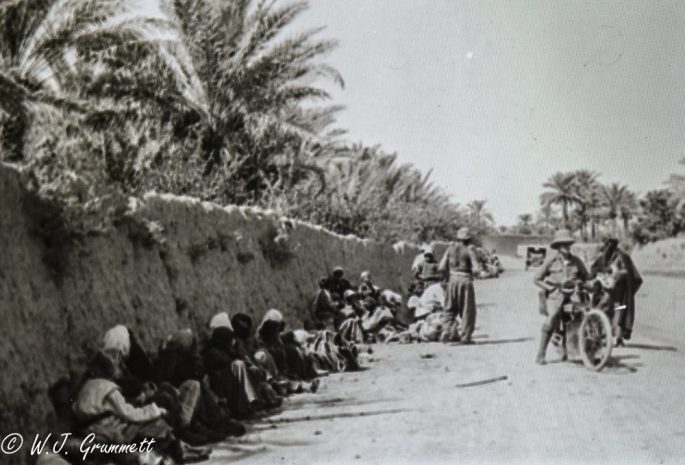
If the British provided any transportation it seems it was only once people could go no further. Will photographed a group of refugees along his section of the route who seem too sick or simply too weak to continue; they sit by the edge of the road against a wall trying to get out of the sun (immediately below). As the Lieutenant in charge of that part of the route he was responsible for their fate. He was given no resources to care for them along the road. I would also speculate that Will’s superiors told him he would not be able to request resources during the operation. Faced with this horrifying situation I think he made his first plea for those in dire need. I think, and the photo series that follows seem to document, that Will asked for, and somehow convinced his Commanding Officer to provide trucks to carry the exhausted refugees the final miles to Baqubah. In the second photograph, below, a large truck is visible in the distance coming toward the refugees. The last image in the series is of several large trucks capable of carrying many people, parked at the spot where the refugees had sat. The refugees are gone, presumably loaded on the trucks, a British soldier is carrying a last pile of belongings to the truck on the left. The meaning of the series of photos seems fairly straightforward and I would like to think that Will and his men were able to get these people quickly to medical help at the Baqubah camp.


For two and a half months, until all the refugees at Hamadan had made their way to Baqubah, Will served as protector and escort along his 60 miles of that bloody road. He watched them struggle along it, he witnessed them die upon it and he did what he could to pass 57000 lives on to the Baqubah camp where, with the care and shelter provided there, they might survive. Recalling the events in his letter to the Globe and Mail, Will wrote,
“The memory of it will stay with me long after details of the military campaign in Mesopotamia have passed away and been forgotten.”
The helplessness must have been nearly unbearable.
The war in Mesopotamia officially ended on October 30, 1918 with the signing of the Peace of Mudros. The First World War as a whole, came to a close with the armistice on November 11th, 1918. When the last of the refugees made their way to Baqubah in late November or early December of 1918, Will returned to regimental headquarters, now based in the town of Imam Abbas. He was given the choice to continue with the regiment or demobilize as per his enlistment agreement, which was, to serve while the declared war continued. I think he had seen enough suffering, and had been away from his home for nearly 4 years; the prospect of 2 or perhaps as many as 5 years more was simply too much. Will decided to go home and left Mesopotamia for England on December 23, 1918.
Coming in November, the final installment, War’s End and Home.
Many thanks to Tom Mitchell, Archivist Emeritus, Brandon University for discovering the April 30, 1923 letter written by Will Grummett to the Toronto Globe and Mail.

 The First World War through the lens of William J. Grummett, 2nd Lieutenant, Norfolk Regiment